

New Executive Board of the DGEPD and New Editorial Board of the Yearbook
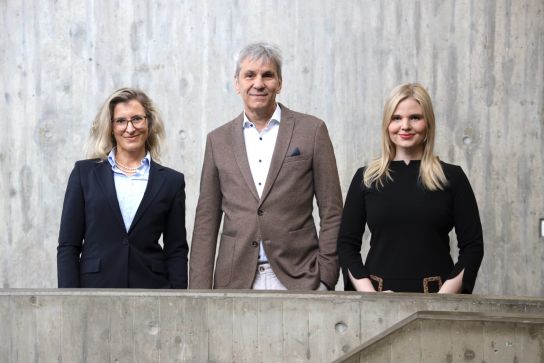
On 11 February 2025, a new executive board of the Deutsche Gesellschaft für Politisches Denken (DGEPD) was elected at the General Assembly. The new President is Manfred Brocker, Professor Dr. Dr. at the Catholic University of Eichstätt-Ingolstadt. The Vice President is Eva Odzuck (left in the photo), and the third member of the board is the Executive Director Sarah Rebecca Strömel (right in the photo; both University of Regensburg).
In cooperation with the publisher Duncker & Humblot, the DGEPD publishes a peer-reviewed academic journal on an annual basis. The DGEPD executive board serves as the editorial board of the Jahrbuch Politisches Denken. The circle of editors has now been expanded by two new members: since March 2025, it also includes Julian Nida-Rümelin, former Minister of State, and Jan-Werner Müller, Roger Williams Straus Professor of Social Sciences and Professor of Politics at Princeton University.
The DGEPD executive board is delighted that, with this expanded editorial team, it will be able to further develop a strong focus on political theory and philosophy, the history of ideas, and democracy research, while also advancing the internationalization of the Jahrbuch Politisches Denken.

About the German Society for the Study of Political Thought
The German Society for the Study of Political Thought (Deutsche Gesellschaft zur Erforschung des Politischen Denkens) was founded in 1989. It brings together disciplines such as political science, philosophy, law, economics, sociology, and the historical and cultural sciences to jointly explore the foundations of political action in the past and present.
Political thought concerns the ways in which human communities organize and coordinate their collective life. It finds expression in writings, speeches, and discussions, in posters, flyers, and political programs, in journalistic and literary works, in art, and in the prevailing ideas that shape an era. The diversity of these sources demonstrates why the study of political thought can only succeed through the collaboration of different disciplines and methodological approaches.
Political thought underlies political action, and political action can only be sufficiently understood by referring back to political thought. Terms such as “freedom,” “equality,” and “fraternity” embody specific strands of political thought that have shaped history.
The study of political thought thus contributes to a better understanding of the history and present of politically active people and helps to uncover patterns of thinking and horizons for action that are crucial to shaping the political future. In line with the society’s objectives, the Yearbook of Political Thought has always promoted interdisciplinary scholarly research that addresses political thinking in all its breadth and international scope, as well as the exchange between political thought and political practice.