

Yearbook Political Thought
The Yearbook Political Thought (Politisches Denken) has been published since 1991 in cooperation with the German Association for the Study of Political Thought (DGEPD). In 2004, the publication moved from Metzler Publishers to Duncker & Humblot, where the yearbook was published as an independent series up to and including issue 28 (2018), released in June 2020.
With the publication of issue 29 (2019) in July 2021, the Yearbook Political Thought underwent a process of further development and transformation, shifting from a traditional yearbook format to a research-oriented journal with a focus on politics and political theory. The guiding principles, however, remain the same as in 1991: politics—the political—cannot be treated as a detached object of study. For this reason, engagement with practical questions of political cooperation and conflict continues to play a central role.
In line with the objectives of the Association, the yearbook has always promoted interdisciplinary scholarly research that addresses political thought in its full breadth, as well as exchange between political theorists, public intellectuals, and practitioners of politics. Accordingly, the yearbook is devoted to fundamental questions of the political. It brings together contributions from all areas of political life and seeks to engage both academic scholarship and politically interested citizens. The volume is complemented by review essays conceived as critical surveys of works, literature reviews, or contributions that situate publications within a broader research context. Each yearbook also includes a number of book reviews intended to provide an overview of current research and publication trends.
The yearbook is edited by Manfred Brocker (Eichstätt-Ingolstadt), Jan-Werner Müller (Princeton), Julian Nida-Rümelin(Munich), Eva Helene Odzuck (Regensburg), and Sarah Rebecca Strömel (Regensburg).
The broadly composed Advisory Board, which advises both the DGEPD Executive Board and the editorial team of the yearbook, currently includes: Luca Basso (Padua), Annabel Brett (Cambridge), John Dunn (Cambridge), Kinch Hoekstra(Berkeley), Peter Hoeres (Würzburg), Otfried Höffe (Tübingen), Christine Lubkoll-Klotz (Erlangen), Quentin Skinner(Cambridge), and Barbara Zehnpfennig (Passau).
All submitted manuscripts undergo an anonymous Double Blind Peer Review process in accordance with the requirements of ERIH PLUS. Authors are asked to consult the manuscript guidelines available on this website and to submit their manuscripts in anonymized form to the editorial office:
Prof. Dr. Dr. Manfred Brocker
Catholic University of Eichstätt–Ingolstadt
Faculty of History and Social Sciences
Chair of Political Theory and Philosophy
Universitätsallee 1
85072 Eichstätt
E-mail: manfred.brocker_at_ku.de
The Editorial Team



Overview of the Yearbooks
Description
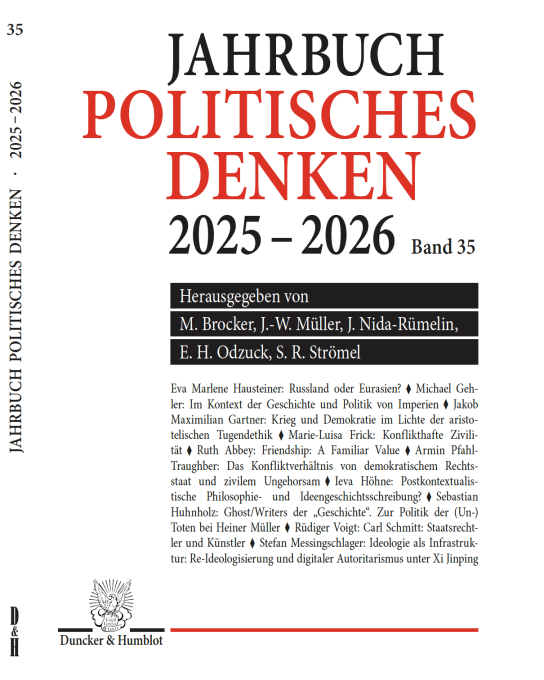
The new double issue of the Jahrbuch Politisches Denken addresses current geopolitical conflicts and tensions within liberal democratic orders. Its central themes include Russia’s politics of history, digital authoritarianism in China, the war against Ukraine, and questions of war, democracy, and polarisation. Further contributions examine civility, friendship, civil disobedience, human rights, and cosmopolitan justice, linking these themes to perspectives from the history of political thought and methodological debates—from Hobbes, Heiner Müller, and Carl Schmitt to Hannah Arendt. The volume opens with an obituary reflecting on Jürgen Habermas as a political thinker.
Description
The new volume of the Jahrbuch Politisches Denken is devoted to key questions of our present time: the war in Ukraine, its historical preconditions and political consequences, the constitutional principle of militant democracy, as well as further fundamental theoretical questions of political order. Alongside contemporary analyses, the yearbook also brings together reconstructions from the history of ideas and critical perspectives—ranging from Carl Schmitt’s friend–enemy conception to Carl von Clausewitz’s reflections on war and Enlightenment.

Description
The 2023 volume of the Jahrbuch Politisches Denken likewise remains closely attuned to contemporary political developments. Contributions address, among other topics, the history of political ideas in Josephus Flavius, the relevance of Georg Wilhelm Friedrich Hegel for European politics, the relationship between literature and politics, republican thought, and the war in Ukraine as a tectonic rupture of the postwar order. The reviews section places a stronger emphasis on current and contemporary debates—a focus the editorial team intends to pursue deliberately in the future.
Description
Although the 2022 volume of the Jahrbuch Politisches Denken was published only in 2023—due to the substantial workload involved in the editorial processing of the contributions and a change in editorial personnel—it nevertheless represents one of the most extensive issues the journal has produced in a long time. This is due, on the one hand, to the contributions themselves, which—particularly in the field of intellectual history—exhibit considerable argumentative depth as well as a dense engagement with sources and interpretations. On the other hand, it reflects the volume’s focus on the fundamental transformations in political thought across the Western world brought about by the war over Ukraine.
Description
The 2021 volume of the Jahrbuch Politisches Denken thematically bridges the history of ideas and analyses of the present. The contributions offer fresh perspectives on fundamental categories of political thought—ranging from Eric Voegelin’s concept of “articulation,” to a hermeneutical refinement of Carl Schmitt’s friend–enemy distinction, and a political-theoretical analysis of pandemic, state of exception, and freedom. At the same time, the yearbook turns its attention to global lines of conflict, examining China’s COVID-19 policy in light of philosophical traditions as well as the strategic competition between the United States and China.
Description
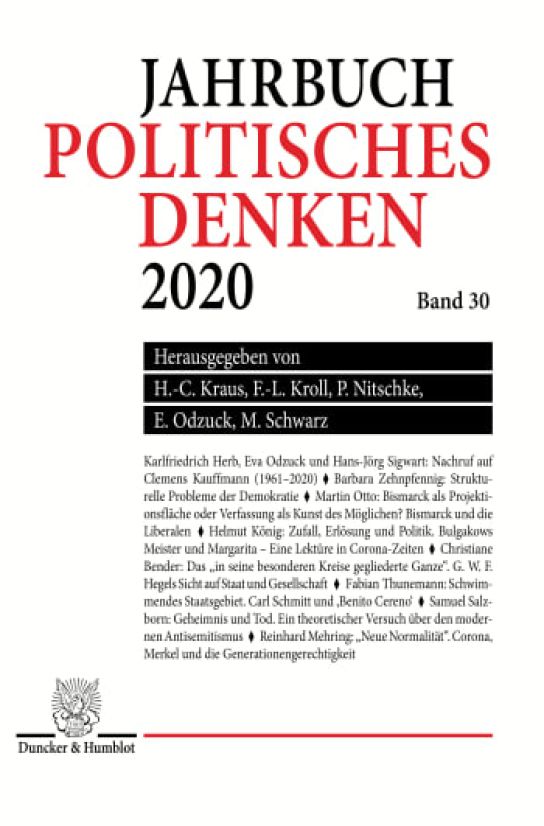
The year 2020 was a Hegel year. Even though this aspect receded somewhat amid engagement with the pandemic, the volume deliberately includes a contribution addressing it—yet not in the conventional mode of the history of political ideas, but from the perspective of the thinker’s systemic relevance for the present. In this respect, the 2020 volume as a whole moves closer to a contemporary vantage point, certainly also as a result of the current state of debate, from which a critical reflection on how the pandemic is addressed—both within politics and by politics—emerges as a lasting task for political thought. With one contribution, this issue initiates such a reflection, which will continue to play a significant role in future volumes.

Description
The year 2019 marked an anniversary for Jürgen Habermas, who celebrated his 90th birthday and once again presented the scholarly community with an impressive demonstration of his depth of creative reflection in his two-volume work Auch eine Geschichte der Philosophie. Against this background, the editorial team established a small Habermas focus for the 2019 yearbook, addressing his work from different perspectives through both a research article and a review essay. Beyond this focus, the individual contributions open up a wide thematic range covering various aspects, authors, and epochs of political thought; unlike some other volumes, the present issue did not emerge from a specific conference. Notably, a number of early-career scholars also contributed actively to this volume.
Description
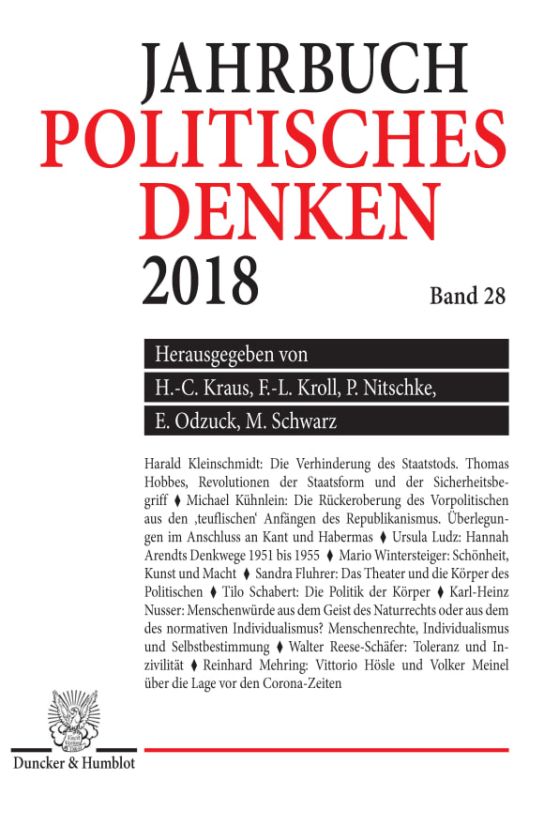
This 28th volume of the Jahrbuch Politisches Denken demonstrates the versatility of the interdisciplinary approach to which political thought is conceptually committed. With an open eye—also toward new questions—the volume presents contributions from the 2018 annual conference in Tutzing by Sandra Fluhrer, Thilo Schabert, and Karl-Heinz Nusser, alongside topics addressed independently of the conference. Thus, Walter Reese-Schäfer takes up the classical question of tolerance in a contemporary constellation, while Harald Kleinschmidt reflects on Thomas Hobbes, and Ursula Ludz offers new interpretations of Hannah Arendt. Mario Wintersteiger examines the tension between art and politics.

Description
The 27th volume of the Jahrbuch Politisches Denken brings together contributions that once again convincingly demonstrate that political thought, in the full breadth of its articulations, can only be grasped through an interdisciplinary approach and through research that transcends both epochs and academic disciplines. A look at the sources with which the authors engage—including, quite naturally, works of fiction—already illustrates this wide scope, not least with regard to its methodological implications.
Among the thinkers examined in this volume are Carl Schmitt, Friedrich Nietzsche, Friedrich Dürrenmatt, Joseph von Radowitz, Jürgen Habermas, and H. G. Wells. The thematic range of the essays extends from biopolitical and geopolitical issues to hermeneutical questions and methodological aspects of researching political thought, as well as to the field of European studies.

Description
The 2016 volume of the Jahrbuch Politisches Denken is marked by controversy. A current focus discusses the foundations and the state of the European integration process. Frank-Lothar Kroll lays bare the historical and geopolitical foundations upon which a European way of thinking has taken shape. Jürgen Gebhardt points out that the European Union can only meaningfully understand itself if it conceives of itself as part of the construction of “the West” from a transatlantic perspective. Karl Albrecht Schachtschneider formulates a fundamental critique of the European Union’s integration process from the standpoint of constitutional law. This critique can, following Emanuel Richter, be classified as one of those “new narratives” that themselves belong to the democratization of the EU.
Controversy also characterizes the remaining contributions: Manuel Becker puts the “Humboldt myth” to the test, Rainer Enskat polemicizes pointedly against current higher education policy, and Felix Dirsch examines the value foundations of democracy. In addition, noteworthy interpretations are offered by the Italian scholars Cristiana Senigaglia and Pierpaolo Ciccarelli on the German thinkers Max Weber, Edmund Husserl, and Leo Strauss.
The book reviews that conclude Volume 26 address recent publications by and about Lothar Fritze, Raul Heimann, Otfried Höffe, Christoph Hübner, Aurel Kolnai, Wolfgang Neugebauer, Samuel Salzborn, and Carl Schmitt.

Beschreibung
The focus of the first part of this year’s Jahrbuch Politisches Denken is on German constitutional law scholars of the twentieth century. Martin Otto edits letters written by Ernst Forsthoff to Walter Mallmann in 1947. Hasso Hofmann comments on Carl Schmitt’s correspondence with Rudolf Smend, Ernst Forsthoff, and Ernst Rudolf Huber, while Rainer Enskat examines recently published portraits of prominent constitutional law scholars from a philosophical perspective.
A further section brings together new studies covering a broad spectrum of political thought—from international law and Theodor W. Adorno’s pedagogy to a debate on republicanism and pluralist politics in Leo Strauss. The review essays and reviews published in the third and fourth parts offer insight into twentieth-century political thought, including its roots in the history of ideas, its transcultural oscillations, and its diverse literary genres.
Description
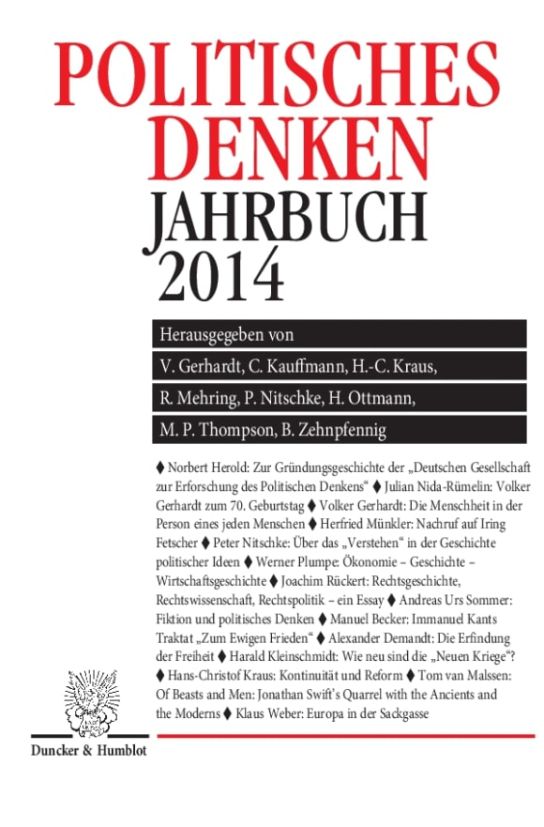
This volume of the Jahrbuch Politisches Denken marks the 25th anniversary of the Deutsche Gesellschaft zur Erforschung des Politischen Denkens (DGEPD). In this context, it includes a contribution on the society’s founding history. A second focus turns to questions of method: across four essays, the relevance of hermeneutical, historical, and philosophical approaches to the study of political thought—and its significance for contemporary society across disciplinary and educational boundaries—is made clear. The third part explores the spectrum of political thought in its full breadth, ranging from Greek and Roman antiquity through the Enlightenment and Romanticism to current questions.

Description
On the occasion of the fiftieth anniversary of Eduard Spranger’s death, the 2013 volume of the Jahrbuch Politisches Denken opens with a thematic focus on his humanities-based pedagogy and its fate within today’s educational landscape. […] The focus highlights the importance that a pedagogy grounded in the humanities holds for the political culture of modern democracies, as well as the yearbook’s interest in the manifold challenges posed by current developments in education (not only political education). […]

Description
The 2012 volume of the Jahrbuch Politisches Denken features a topical focus on the state of the rule of law and democracy. Bernd Rüthers and Clemens Höpfner open the volume by identifying current phenomena and tendencies toward “breaches of the law” by government and the judiciary. By contrast, Volker Neumann defends the tradition of legal positivism, while the ancient historian Alexander Demandt explores earlier erosions of democracy from a broad, universal-historical perspective.
A second focus marks the 300th anniversary of Jean-Jacques Rousseau, with contributions by Alfons Söllner, Skadi Krause, Gérard Raulet, Reinhard Mehring, and Frank Schale. Following a “declaration of love” for Rousseau’s The Social Contract and a look at the prehistory of modern natural law, the section offers a detailed account of the reception of Rousseau in Germany up to the postwar period.
In addition, the yearbook includes further contributions on the theory of writing the history of political ideas, on Niklas Luhmann’s concept of the state, and on the Italian debate surrounding the “social market economy,” as well as review essays and book reviews, among others by Alessandro Somma, Herfried Münkler, Bernd Rüthers, and Volker Gerhardt.
Description
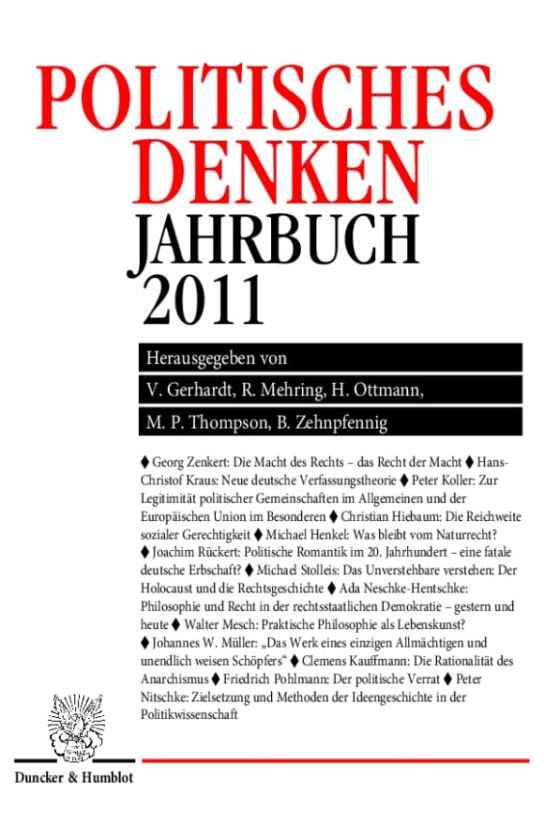
In 2011, the Jahrbuch Politisches Denken is devoted to the central theme of “Legal Culture,” approached from a wide range of disciplinary perspectives. Topics addressed include, among others, the relationship between power and law, the legitimacy of a political institution such as the European Union, recent constitutional theory, and the judiciary under the Third Reich. The particular appeal of this collaborative undertaking lies in the fact that legal culture is examined in all its complexity and considered from political science, philosophical, historical, and, of course, legal perspectives.
The second part of the volume brings together essays that engage with current issues—such as political betrayal using the example of WikiLeaks—as well as historically and systematically oriented reflections, including practical philosophy as an art of living, the rationality of anarchism, and critiques of the Cambridge School. In keeping with the aims of the Jahrbuch Politisches Denken—not only to provide a forum for different disciplines but also to encourage methodological diversity—this section likewise represents a broad spectrum of ways of thinking politically and of thinking about the political.
The third part consists of individual reviews as well as more extensive review essays, which examine either a single author or an entire thematic complex in greater depth. In its overall conception, the yearbook is not addressed to representatives of a single discipline, but to all those who wish to engage with the phenomenon of politics in a rigorous and demanding manner.

Description
The 2010 volume of the Jahrbuch Politisches Denken comprises six essays on a range of topics in political thought, including human rights and the relationship between religion and politics in Thomas Hobbes, Carl Schmitt, and Paul the Apostle. In addition, under the thematic focus “Perspectives of Political Theory,” the volume documents a conference held by the Deutsche Gesellschaft zur Erforschung des Politischen Denkens (DGEPD) on the eve of the Day of German Unity and twenty years after the fall of the Berlin Wall at the Berlin-Brandenburg Academy of Sciences and Humanities.
The aim of the conference was to make visible the significance of political theory for political culture as a whole, to communicate its competencies and profiles to a broader public, and to demonstrate its relevance in direct exchange between scholarship and politics. On the one hand, the contributions address the situation of political theory in Germany, Italy, Poland, and the United States; on the other, they examine its function in democracy and everyday political life, its relationship to the public sphere, and its role within political science. The articles do not articulate an official position of the DGEPD but rather introduce the individual authors’ perspectives into public debate. By contrast, the Berlin Declaration, also published in this volume, was adopted by the General Assembly of the DGEPD. A series of reviews of recent politically relevant publications concludes the volume.

Description
Twenty years after the peaceful revolution in the GDR, a widespread tendency has emerged to romanticize the SED dictatorship. This attitude is troubling in its effects on political culture in Germany, for a society that fails to name injustice as such will find it difficult to develop the rule of law and an ethics of democracy.
Coming to terms with totalitarian experience shapes political culture; at the same time, an open engagement with past injustice presupposes a particular legal and moral orientation on the part of citizens. The contributors to this volume examine the manifold connections between the reckoning with the past and political culture. The essays are based on papers presented at a conference organized by the Deutsche Gesellschaft zur Erforschung des Politischen Denkens and the Stiftung Ettersberg (Weimar, September 2008).
Description
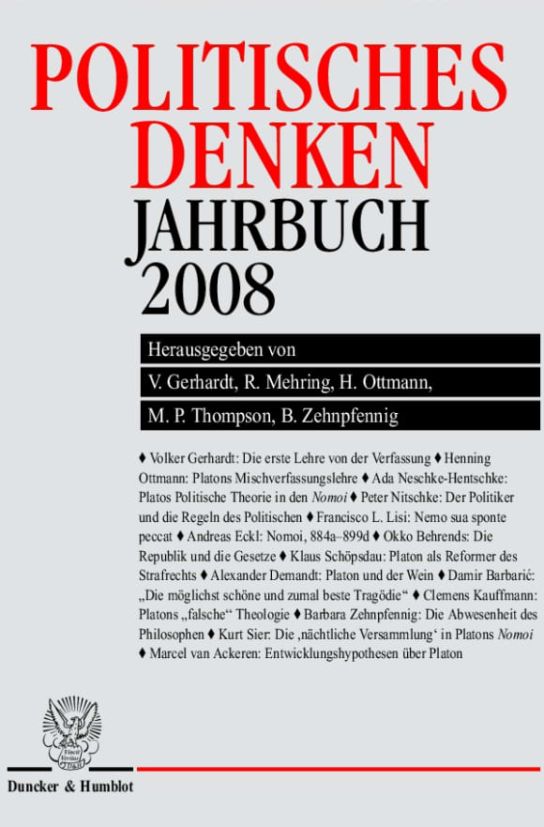
The 2008 volume of the Jahrbuch Politisches Denken, edited by Barbara Zehnpfennig, is devoted to the theme “The Rule of Laws and the Rule of Human Beings—Plato’s ‘Nomoi’.” Historians, political scientists, philosophers, legal scholars, and classical philologists engage with Plato’s major late work, the Nomoi (The Laws), to address the fundamental question of the extent to which a legal-constitutional order can compensate for the shortcomings of human rule.
The volume is not only an innovative contribution to Platonic scholarship. Rather, the various disciplines find in Plato’s conception of law and constitution points of departure for reflections of general significance: the problem of the constitution as such; the relationship between nature, ethics, and politics; the foundations of criminal law norms; and the relationship between politics and religion. However different the methodological approaches may be, there is broad agreement that ancient political theory still has much to say to modernity. In its plurality of methods and interpretations, this volume thus reflects the current state of scholarship, while in its subject matter it addresses a problem that transcends time: the proper relationship between politics and law.
Description
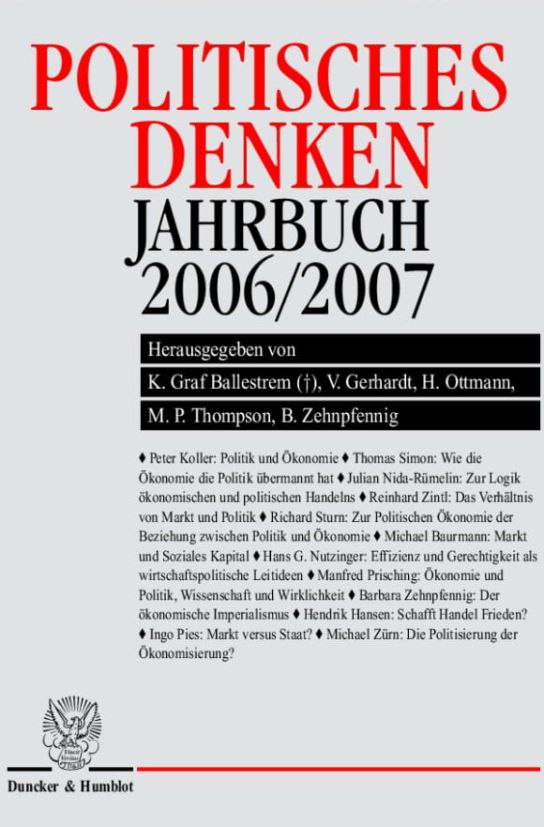
Politics and economics are linked by close yet tension-filled interrelations. On the one hand, they are mutually constitutive: the institutional framework of the economy requires political regulation, while the scope of political action depends on economic conditions. On the other hand, they come into conflict when politics counteracts the inherent dynamics of a functioning economic order, or when the economy undermines the conditions necessary for a political order committed to the common good. The contributors seek to illuminate this complex relationship between politics and economics from different perspectives. Their essays are organized into four thematic groups.
The first group addresses foundational questions: the concepts and general systemic properties of politics and economics, their historical development in the modern era, and the respective logics of political and economic action. The second thematic group examines differences and interdependencies between politics and economics, focusing on interactions and points of friction between markets and politics, the functional domains and limits of each, and the socio-moral preconditions of a market economy. The third group discusses methodological problems in the sciences of politics and economics, including the role of efficiency and justice in economic theory, the difficulties of economically modeling party competition, and the attempt to provide an economic justification of morality. The fourth group is devoted to pressing contemporary issues: whether increasing trade interdependence contributes to world peace; how globalization should be conceptualized in order to point the way toward an appropriate institutionalization of transnational politics; and which instruments exist to politically domesticate the growing self-dynamics of the global economy that increasingly elude the control of nation-state politics.
Description
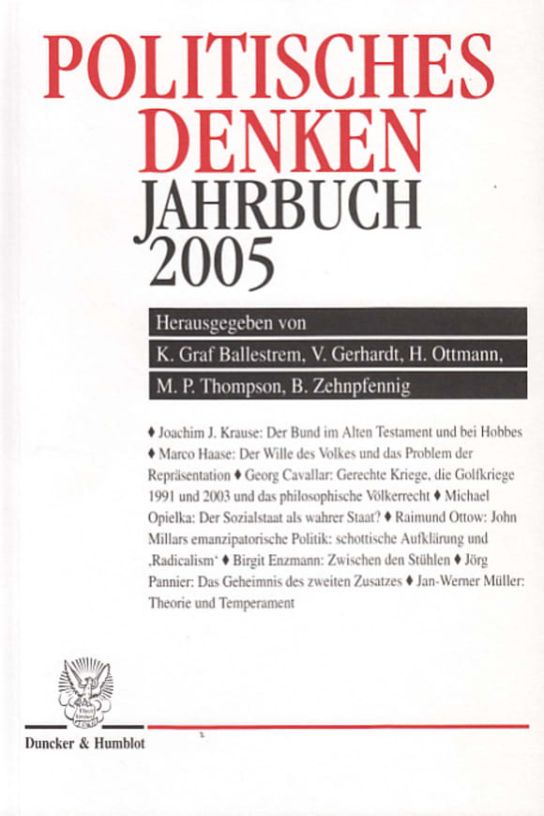
The 2005 volume of the Jahrbuch Politisches Denken continues its established focus on fundamental issues in political and legal theory as well as on selected current questions of the political situation. Joachim Krause (Tübingen) discusses Thomas Hobbes’s thesis of the “mortal god” in light of Old Testament covenant theology; Marco Haase (Berlin) pursues his illuminating investigations into the problem of representation; Georg Cavallar (Vienna/Budapest) examines the issue of just wars against the background of the two Gulf Wars of 1991 and 2003; and Michael Opielka (Jena) explores Georg Wilhelm Friedrich Hegel’s contribution to political sociology with a view to the welfare state.
In subsequent contributions by Raimund Otto, Birgit Enzmann, Jörg Pannier, and Jan-Werner Müller, a wide thematic arc is drawn—from John Millar’s emancipatory politics, through questions of a procedural theory of the democratic constitutional state in Ingeborg Maus and Jürgen Habermas, the enigma of the second supplement in Immanuel Kant’s Perpetual Peace, to the question of what ultimately remains of the political thought of Isaiah Berlin.
The volume concludes with reviews of recent publications by Sophie van Bijsterveld (The Empty Throne), Friedrich von Halem (Recht oder Gerechtigkeit), Herfried Münkler (Imperien), and Peter Hoeres (Krieg der Philosophen), written by Birgit Enzmann, Nikolaus Lobkowicz, Volker Gerhardt, and Lothar Waas.
Description
Situated at the intersection of political science, jurisprudence, and philosophy, the Jahrbuch Politisches Denken has, for fifteen years now, fulfilled a mediating role that reaches deeply into the individual disciplines. The concept of “political thought” is deliberately conceived in broad terms, encompassing both problems of theory formation and questions of reflective political practice. Through the comprehensive history of political philosophy published by the yearbook’s co-editor Henning Ottmann (Munich) under the title Political Thought, the historical scope of this concept has meanwhile been demonstrated for antiquity and the Middle Ages as a whole. The forthcoming volumes will further show that this concept uniquely integrates theoretical inquiry and political practice conducted under theoretical claims.
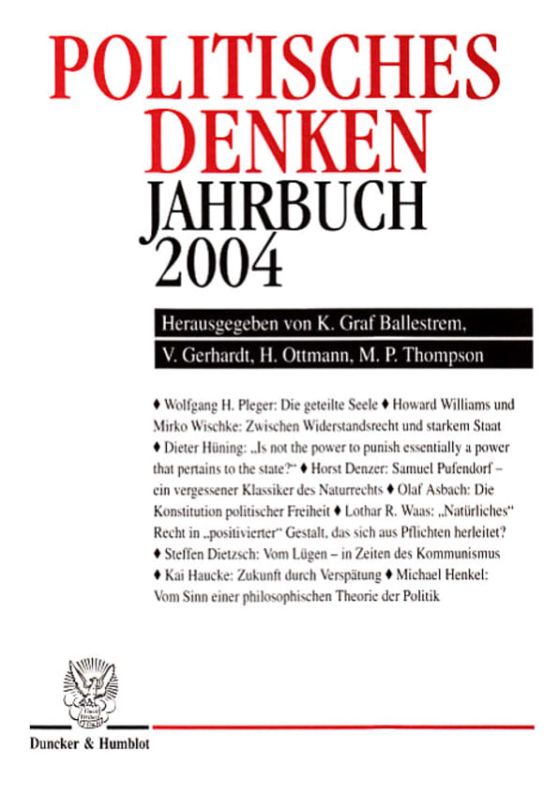
The new volume of the yearbook traces a wide arc—from Plato’s anthropological and ethical foundations of politics, through the reception of Thomas Hobbes in Germany and a reconsideration of Samuel Pufendorf, to discussions of theoretical approaches by Helmuth Plessner and Michael Oakeshott. Further topics include the Enlightenment concept of freedom, lies under conditions of communism, and a contribution to criminal law theory in early modern natural law. In addition, the volume contains reviews as well as obituaries for Norberto Bobbio and Ernst Vollrath.
With its new publishing location in Berlin, the Jahrbuch Politisches Denken has strengthened its ties to parliamentary practice in the Federal Republic of Germany. The editors seek to critically accompany the strategic debates of political parties and to address the major programmatic questions of social democracy in Germany through analytical means. Practitioners are also given a voice, contributing theoretical impulses drawn from their political work.
Until 2003, the Jahrbuch Politisches Denken was published by J. B. Metzler. With the present 2004 volume, the publication has been transferred to Duncker & Humblot.